Protest and Elitist Culture.
Why Did the Youth of America reject the leisure wealth and comfort of middle class suburbia?
in this Blog: We discuss the causes and effects of the generation gap and how did the youth of America reject the values and traditions of their elders. Then another challenge to the middle class came from the very top echelons of America.1. O What a Lovely War - The USA has a technological boom at the end of WW2.
2. The Baby Boomers - Middle class babies were popping out everywhere in the postwar years.
3. You would think everyone would be enjoying the new prosperity - But they weren't and there was this place. . . called Vietnam.
4. Entitlement - The silent generation believed in obedience and loyalty to a government, but the new generation began to change.
5. The Generation Gap - The youth were educated now and began to ask uncomfortable questions.
6. Keeping up with the Joneses - It was becoming increasingly obvious that materialism was the real religion of the middle class.
7. The New Eden - The promise of materialism was a world where everyone did as they pleased and lived in comfort and luxury.
8. What did the Artists of America have to say about all of this? - Well, not much.
9. Elitist and Remote - Just who could related to this strange art that looked totally deranged.
10. What was wrong with these guys? - They seemed to have painted themselves into a corner literally and philosophically.
Introduction
In our previous Blog we drew a parallel between the protesters in Zurich in the great war of 1914-19 and the protesters in the USA during the the late 50's and 60's USA. This was suggested by Robert Hughes in our aforementioned "The Shock of the New".
Of course nobody thinks of the two conflicts as identical situations as there were many very obvious differences between the two. Of course a very obvious common theme is the idea that older people can order younger people/men to go and fight a war and die for a cause the didn't believe in or even understand. This is the central connection between the two.
The main difference was the fact that the USA could never have been invaded or ever have lost a war and gone under subjugation. Everybody knew they were safe at home and more people simply could not understand how a little country in indonesia was so important to fight against that more and more young Americans were dying in what was increasingly appearing a lost cause.
1. O What a Lovely War

The iconic image that captured an epic moment in U.S. history - a sailor locked in a passionate kiss with a nurse in New York City's Times Square just after hearing the announcement, the War is Over. . .
The iconic image that captured an epic moment in U.S. history - a sailor locked in a passionate kiss with a nurse in New York City's Times Square just after hearing the announcement, the War is Over. . .
After 1945 - AS a direct result of the acceleration of Industrialisation in the second world war. America experienced an unprecedented technological boom, evidenced by a proliferation of gadgets and appliances relentlessly marketed and willingly purchased by the average American household.
The standard of living in the USA was now the highest in the world.

2. The Baby Boomers
At the end of the war there was a spate of breeding in the USA and the post war generation "Baby Boomers" entered a world that was vastly different from that of their parents.
There are no precise dates when the Baby Boomer birth years start and end. Typically, they range from the early-to-mid 1940s and end from 1960 to 1964.
Since I was born in 1961 this makes me a Baby Boomer technically, but I was far too young to experience the Hippy generation.
 |
| These Baby boomers are the first generation born after the war into what was now the most prosperous country the world had ever known! |
3. You would think everyone would be enjoying the new prosperity
But by the 1960's it was clear that something had gone horribly wrong, things were not as hunky dory as it appeared and the young people who had grown up to college age had become severely disaffected.
Was there another mass slaughter they were protesting against?
Well not exactly like the great war - but there was this strange event going on in Vietnam.
 |
| American Soldier at a Burning Saigon Village |
Why exactly were Americans being shipped and flown to some obscure far eastern country? What kind of threat could they possible pose on the most powerful and wealthy country in the world?
Well the complications were many and the politics were convoluted. But an average draft age US citizen of 18 years old had no real understanding of all that.A young man in the USA in the mid 1960's was about to enter the wider world of experience, he had been living a leisurely and comfortable life when he became clear to him that a tour of duty in Vietnam was not actually the exciting adventure he had been led to believe. It began to dawn on him that other young men his age, some he had maybe have even known personally, were actually dying quite regularly and being brought back to their distraught parents in body bags.
 |
| The idea to honor and serve unquestioningly was a state of mind that no longer held any power in the imaginations of this new generation. |

4. Entitlement
One of the results of living in a wealthy country with a good system of education is that kids grow up with a sense of entitlement and privilege, they begin to develop a sense of self-awareness importance and destiny, which did not include dying in some mosquito infested jungle far away from home.
The previous generation did not always have the opportunities of their children and often were sent off to work in their teens and basically stayed there (often in the same job) till retirement.
They remembered well 1929 and the poverty and misery that ensued as a result of the stock market collapse.
They then had to live through the years leading up to and during the second world war where rationing and privation was the normal state of affairs.
 |
| Bread Lines during the depression |
Silent Generation - The previous generation were called the "silent generation" by this it was meant they generally did what they were told and not only willingly volunteered to go off to the slaughter house of World War 2 but also considered it a matter of honor to do so.
 |
| Army recruitment posters 2nd World War and Vietnam |
5. The Generation Gap
They began asking uncomfortable questions, about the government, Education, Schools and religion they began to rebel against authority in all its forms, Parents were horrified, psychologists tried to figure out what was going on.
Why was it that with all that privilege and luxury there appeared to be a total break down off traditional value systems.
Truth be told, the older Generation had themselves already abandoned the old values of honour, service, Sunday Church and the nuclear family - but still supported the conservative codes of behavior.
When these became challenged by a developing youth, they had no real answers, except for "This is the way we have always done it so therefore it must be right".
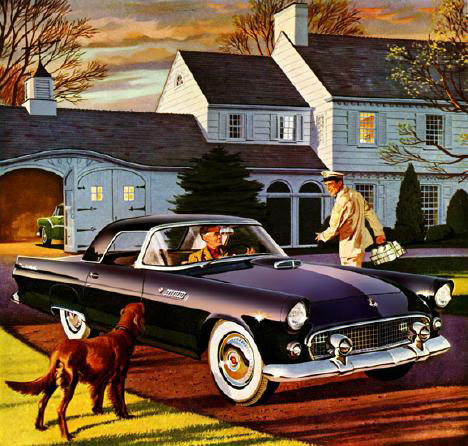
6. Keeping up with the Joneses
To be satisfied with a home and food on the table and clothing to wear was no longer enough for the post war parents. They had experience of the shortages of basic necessities during the depression years. Now things were looking up. . .
They had never had it so good. . . and keeping up with the neighbors became an obsession . . .
and
A specific hall mark of consumerism that subsequently became an object of scorn for their children who would reject its superficial competitiveness and the subsequent pretense and denial that went with it.
7. The New Eden
It seems there was a snake in this Eden as well
Family structures seemed to begin to disintegrate as previous taboos such as divorce and sexual promiscuity began to occur more and more frequently. Adultery and fornication, so frowned upon and guilty parties were treated almost as pariahs, was becoming part of the modern world. Inevitably taboo agendas became more relaxed, which of course opened the door for further changes and shifts from well entrenched society norms and customs.

There was a conservatism that was inherited and adhered to. . . in principle, but now seemed stifling and unrealistic, without real conviction. . .The new Religion of America, was materialism.
8. What did the Artists of America have to say about all of this?
Not much it seems. American Art in the 1950's was obsessed with Modernism, at least the wealthy elitists seemed to be - this seems to have been in retrospect an experiment run almost exclusively by mega-wealthy new York Jews such as Guggenheims and the Arensberg's as well as other elitists like the De Menils and the Dreiers. |
| Jackson Pollock 1951- He found a drip formula that was very appealing to the Modernists but the public was mystified and suspicious. |
9. Elitist and Remote
Abstract Expressionism - so daring, so modern and new and . . . . totally incomprehensible.
It's brazen challenge to all dearly held values of what constituted Art was an affront to the conservative Americans who in general had completely missed the point.Was this 'modern Art' some kind of joke? Was it an in-house phenomenon that only the "initiates" and the wealthy could ever hope to be a part of? A huge divide opened up between the "high brow" (the elite) and the commoners the "low brow" who were too provincial to understand the aims and intentions of the "new Renaissance".
Just an interesting aside: Jackson Pollock was a Pupil of the arch-nemesis of abstraction, Thomas Hart Benton. . . and throughout his career he was plagued with feelings of guilt and believed he was a total fake. Instead of milking the gravy train and making a fortune he was wracked with all kinds of mental hangups which he medicated with alcohol and eventually put himself out of everyone's misery, by crashing his car whilst driving under the influence . . . He was in his early 40's. . .
But this self-destructive tendency was not unique to Pollock. . .
 |
Instead of the agitated brush work of the "action Painters"
Rothko opted for large bands of ethereal colour combinations.
|
Mark Rothko, new York abstract expressionist Artist, tormented soul.
Clement Greenberg championed his approach as a way beyond the drip and splat by Pollock. But by now it was becoming a literary movement rather than a visual one.
He made it big in the late 50's and 60's but struggled with depression and eventually took his own life.
10. What was wrong with these guys?
Who wouldn't be absolutely thrilled at being a celebrated Artist in New York in the 1950's?Abstract Expressionism was a fascinating attempt to redefine what painting is meant to be, as well as an attempt to assimilate new philosophical approaches in the 20th Century.
These were born out of the wide acceptance of Darwinism and it's accompanying philosophical writings, Existentialism and more specifically, Nietzsche's attempt to reconcile man with the new Nihilism and to forge a whole new outlook on reality, that excluded any possibllity of the supernatureal and specifically - God.

Perhaps the depressing realisation that the world is without meaning, direction or purpose was a bit much for these sensitive souls who swallowed the Darwinist paradigm as absolute fact, hook line and sinker, and with this conviction, life became totally increasingly meaningless and pointless. Marcel Duchamp must have been chuckling behind his chessboard, saying you see? I told you.
Initially the new abstract Art may have seemed full of joyful possibilities for innovation and experimentation, but was not long before it began to look repetitive and the art scene had painted itself into a corner. Innovation began to run dry and the movement began to implode on itself, after only a Decade it was beginning to look dated.
But not before it was redefined with "Pop Art" a very refreshing and clever attempt to maintain the ideals of Abstract expressionism whilst revitalizing it. More about this later. . .
 |
| Wham - Roy Lichtenstein 1963 |


Comments
Post a Comment