03. A Tale of two Cities - Zurich
DaDa the Cabaret of Dissent
In this Blog - we focus on Dada and its post war legacy in the USA
Introduction
1. The second episode of "The Shock of the New" - Robert Hughes discusses the story of a group of dissenters who escape the savage violence of the war by high tailing it off to the nearest neutral country, switzerland.
2. Hugo Ball and Karawane - The mock ritual at Cabaret Voltaire.
3. The Irony of Hugo Ball - In a supreme change of heart, Ball totally turns his back on DaDa.
4. The Beginnings and reason for the Generation Gap - Robert Hughes speaks of a gap between "official Language" and the experiences of the soldiers in the trenches.
5. The German Revolution - The German Monarchy abdicates and is replaced by the Weimar republic.
6. Post War Germany - In an air of disillusionment and pessimism places such as Berlin become centers of Hedonism.
7. Berlin DaDa - Richard Huelsenbeck brings to Berlin the radical extremes of the Zurich crowd.
8. The Bauhaus - In spite of the nihilism and excesses of the Berliners all was not doom and gloom.
9. Paris DaDa - This was launched by another DaDa original of Zurich, Tristan Tzara who met another fascinating character who headed up a whole new movement.
10. Andre Breton - A radically minded young poet traumatised by his experiences in the great war recognised the potential of DaDa to use in expressing his own imaginative aspirations.
11. Marcel Duchamp - Moves to New York taking with him his own brand of DaDa with provocation as its root concept, its the first step in exporting DaDa overseas to America.
Introduction
1. The second episode of "The Shock of the New" - Robert Hughes discusses the story of a group of dissenters who escape the savage violence of the war by high tailing it off to the nearest neutral country, Switzerland.In the TV series "The Shock of the New" Robert Hughes talks about the development of Art in the 20th Century. His series is obviously an overview and in it he builds a Chronological progression of movements in Art. There were external Historical factors that contributed towards the need for a creation of new forms of expression that could express and reflect the utterly unique modern experiences of humanity. Clearly WW1 was a major event and indeed a vast epic that left an enormous and horrifying scar on the consciousness of all who had direct and indirect involvement.
But there are many more almost as equally explosive and important that may not be as obvious. Perhaps the rise of secularism already well under way by the end of the 19th Century, Darwin, Marx and Nietzsche the rejection of Christianity and the void this created in the minds of man.
The retelling from the hindsite of modern times, is also a significant factor on the interpretation of Historic events. Hughes was clearly a product of his age and his engaging approach was certainly affected by the need to entertain TV viewers who were not necessarily interested in Art History. But his refreshing approach way back in the 80's is also of Historic interest to viewers today and the approach to Scholarship and TV documentaries have also evolved. Perhaps a program like "The Shock of the New" wouldn't even make onto TV in this superficially charged ratings hungry media world we know today.
In this over view there is an attempt to analyse the progression in a different story format in which key questions are examined that Hughes did not focus on. If we need to spend time on a certain area we have the freedom to do so since there is absolutely no pressure to satisfy a client or a public. Having said that it is no less fascinating and no less entertaining, simply because the story itself is an amazing adventure to follow.
One of the ideas he does cover is discussed in in The Shock of the new Ep. 2 - The Powers That Be, is the History and legacy of the DaDa movement. The effects are still being felt today.
So we kick of our discussion in a recap of the what actually transpired in a small out of the way makeshift cabaret theatre in the backstreets of Zurich Switzerland in 1914
 |
| "The Cabaret Voltaire. Under this name a group of young artists and writers has formed with the object of becoming a center for artistic entertainment. In principle, the Cabaret will be run by artists, permanent guests, who, following their daily reunions, will give musical or literary performances. Young Zurich artists, of all tendencies, are invited to join us with suggestions and proposals." [Hugo Ball, La fuite hors du temps ([1946], 1993) 111]. |
The small group that gathered together in Zurich Switzerland hired a venue which they then name the "Cabaret Voltaire" after another intellectual dissenter from a previous century (which has a certain irony to it, since they wanted to break away from the past. . . the question should perhaps have been - what past, in particular?).
Their activities were playful and fun, although to be sure there was a serious undertone. Did they have any idea the impact their activities were going to have on the future? Probably not, they were young and were really just marking time in a creative way whilst the war raged on in Europe. They were however unlocking a Pandora's box that was to be a fuse of a bomb that was to ignite Europe. The subsequent blast in Zurich then was felt in subsequent waves of DaDa that followed suite all over Europe. If that was not enough it then was to travel across the Atlantic sea and like the Mayflower arrive in the new world to begin a whole new life in New York.
So this blog is an overview, of the ideas and innovations of DaDa and how these were reused in various forms that have persisted in the minds and consciousness of creative people more or less on a continuous basis, right up to the present day.
We could even call it a "Tale of two Cities" . . .
. . . namely Zurich and New York.
 |
| Join the Army they said, It will fun, a great Adventure . . . they said. |
1. The second episode of "The Shock of the New"
Called "The Powers that be", Robert Hughes talks about the disillusionment and horror of the mechanised warfare of the First World War.
 |
| CRW Nevinson, The Harvest of Battle, 1919 |
"The joyful sense of possibility that was born of the machine, had been cut down by other machines."
The powers that be - Shock of the New - chapter two.
A small group of dissenters said "Hell no we won't go" and ran away to a safe haven in Zurich Switzerland. Hugo Ball and his partner Emmy Hennings, a German singer, wanted to create a place where they all could meet and have fun evenings of entertainment. They wrote manifestos declaring their opposition to the war and declared a need to wipe the slate clean and restart culture from scratch. . .
The powers that be - Shock of the New - chapter two.
A small group of dissenters said "Hell no we won't go" and ran away to a safe haven in Zurich Switzerland. Hugo Ball and his partner Emmy Hennings, a German singer, wanted to create a place where they all could meet and have fun evenings of entertainment. They wrote manifestos declaring their opposition to the war and declared a need to wipe the slate clean and restart culture from scratch. . .
On the 11th of February, after Hugo Ball had sent out letters to friends in Germany asking them to come and join, those individuals, who were to become the "hard core" of Dada, began to arrive in Zurich, artist Hans Arp, the Romanians Tristan Tzara and Marcel Janco and Richard Huelsenbeck.
This crowded canvas conveys the chaos, action, sound, and fury of a night at the Cabaret Voltaire.
The jumble of performers, spectators, and inanimate objects fill the overcrowded space to bursting.
One man on stage plays piano, one wrings his hands, one recites and a few dance.
In the audience individuals are seen laughing, enraged, attentive, and also bored.
The artist makes little distinction between the performers and the audience, instead emphasizing the morass of individuals as a whole.
This work provides a vital visual record of the sensory overload of sight and sound engendered by a night at the Cabaret Voltaire.
The Dada artists who developed the idea for the Cabaret hoped to eliminate the distinction between art and life, and by extension, the performer and the audience. Accordingly, their wild Cabaret performances created an atmosphere of anarchy in which provocation was an integral part of the show, the audience would be pushed to the point where they lost control and total chaos would ensure Hugo Ball later recalled how Tzara danced, Janco played an invisible violin, Hennings did the splits, Huelsenbeck drummed, and Ball played the piano as the audience booed, hissed, and screamed in fury.
 |
Cabaret Voltaire - Marcel Janco(1916) |
The jumble of performers, spectators, and inanimate objects fill the overcrowded space to bursting.
One man on stage plays piano, one wrings his hands, one recites and a few dance.
In the audience individuals are seen laughing, enraged, attentive, and also bored.
The artist makes little distinction between the performers and the audience, instead emphasizing the morass of individuals as a whole.
This work provides a vital visual record of the sensory overload of sight and sound engendered by a night at the Cabaret Voltaire.
The Dada artists who developed the idea for the Cabaret hoped to eliminate the distinction between art and life, and by extension, the performer and the audience. Accordingly, their wild Cabaret performances created an atmosphere of anarchy in which provocation was an integral part of the show, the audience would be pushed to the point where they lost control and total chaos would ensure Hugo Ball later recalled how Tzara danced, Janco played an invisible violin, Hennings did the splits, Huelsenbeck drummed, and Ball played the piano as the audience booed, hissed, and screamed in fury.
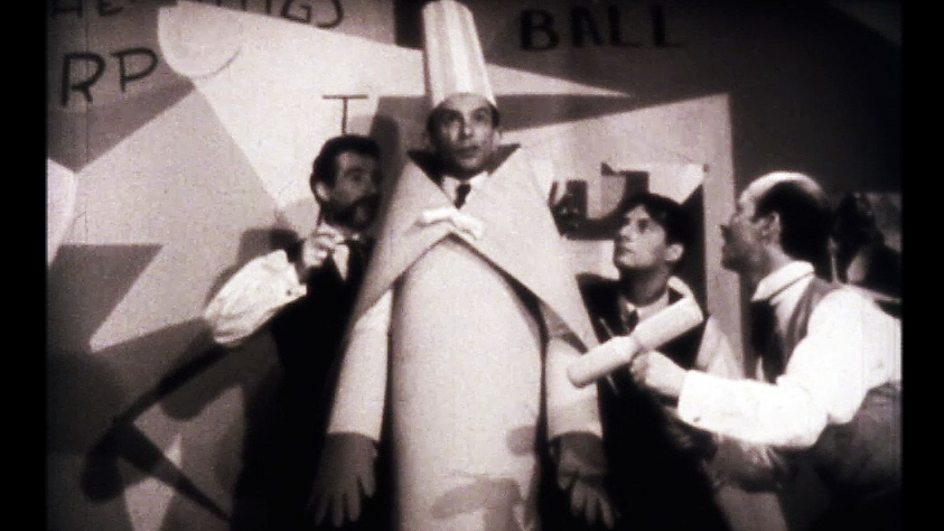 |
| Hugo Ball reciting his nonsense poem 'karawane" |
2. Hugo Ball and Karawane
The photo shows Ball reciting a nonsensical poem dressed up in a cardboard suite and reciting solemn nonsense that obviously mocks the whole concept of some kind of liturgical ceremony.
Religious ceremonies with solemn men wearing all kinds of bizarre regalia dressing up in silly costumes and talking gibberish. Should we revere the spirituality of Ball's performance? Since it is meaningless, the same evaluation applies to the Catholic mass. We can simply make of it whatever we wish to. The whole performance is only given its power by the willingness of the faithful.
The visual artists in the movement, like Ball, embraced the use of unconventional materials like cardboard from which he constructed his outrageous costume for his performance of Karawane. "For us," he wrote, "art is not an end in itself, but it is an opportunity for the true perception and criticism of the times we live in." Thus, a hastily fabricated cardboard costume in which he resembled an earnest cleric while reciting a provocatively nonsensical sound poem - and the poem itself - were vehicles for achieving a larger aim: to dismantle language, particularly as it pertained to imperialism, patriotism, and war.
By mocking the ritual the DaDa performance was taking away its power and exposing it for the meaningless gesture they believed it was. The danger of the ritual and its accompanying paradigm caused death of millions in the War and therefore its power over the minds of people has to be wrong and should be stopped.
Of course this was not really a new idea and Ball just like many young Germans of his day was quite familiar with the writings of Nietzsche who had perhaps a tad prematurely already declared God dead in 1882 in his essay in the "The Gay Science"

By the beginning of the Great War of 1914, the average young German was quite familiar with the writings of Nietzsche and Marx as well as Darwin among others. This is the time of a general acceptance of materialism as the new paradigm of reality admittedly a literary idea but gaining in popularity all the time. The possibility of starting the world from scratch, was a very thrilling prospect for a young artist who had managed to escape the great war.
But exactly how would they go about this once the war had ended?
3. The Irony of Hugo Ball

He retired with his girlfriend Emmy Hennings to a tiny Swiss village, Agnuzzo, where he began the process of revising his diaries from 1910 to 1921, which were later published under the title, Die Flucht aus der Zeit (Flight Out of Time).
Nobody really talks about Ball after he abandoned his compatriots in Zurich. All we know is he had a falling out with Tristan Tzara described in Hans Richter's book. He died young, at age 41 in 1927, poor, in self-imposed isolation and all but forgotten.
4. The Beginnings and reason for the Generation Gap
Well Hugo Ball had perhaps by the end of the war, become tired of the DaDa experiment, but DaDa had by then taken on a life of its own. There were many young men who had managed to survive the horror of the trenches and their eyes had been opened. They were more than willing to revive and develop the ideas and concepts that had first appeared in that little night club in Switzerland.
 |
| Robert Hughes speaks of a gap between "official Language" and the experience of the young men in the trenches. The point is the trust for the leaders of the generation from the top to the bottom was shaken . . . and remains still to this day. . . it has never recovered. |
"In the trenches, millions of young Englishmen, Frenchmen and Germans found the idea that war was something between a joust and a cricket match had been wrecked by inventions which industrialized death, as they had industrialized life. This was what they found and what they became. By 1916 and the summer catastrophes of the Somme battlefield, a whole generation on both sides of the trenches was becoming aware that it had been lied to. Its generals had lied about the nature and the length of the war. Its politicians had lied about its causes. Its journalists and propagandists had lied about what it was like for the troops.
The flood of lies was so great that it seemed to contaminate all official language. And so a chasm opened between official language and what the young knew to be reality. The speech of the elders could not contain their experiences.
America would repeat this trauma in the '60s with Vietnam.
But Europe had it 50 years earlier and the antennae of the crisis were the ones whose business
was language, the writers and artists mostly born between 1890 and 1900, who had been sucked into the vast statistics of the war."
The Powers that be - Robert Hughes - The Shock of the New

BY EDGELL RICKWORD
I knew a man, he was my chum,
but he grew blacker every day,
and would not brush the flies away,
nor blanch however fierce the hum
of passing shells; I used to read,
to rouse him, random things from Donne—
like “Get with child a mandrake-root.”
But you can tell he was far gone,
for he lay gaping, mackerel-eyed,
and stiff, and senseless as a post
even when that old poet cried
“I long to talk with some old lover’s ghost.”
I tried the Elegies one day,
But he, because he heard me say:
“What needst thou have no more covering than a man?”
grinned nastily, and so I knew
the worms had got his brains at last.
There was one thing that I might do
to starve the worms; I racked my head
for healthy things and quoted Maud.
His grin got worse and I could see
he sneered at passion’s purity.
He stank so badly, though we were great chums
I had to leave him; then rats ate his thumbs.
 |
| Someone back home is saying, now why does he never write . . . ? |
Between April and August 1918, the German army decided to make one last, determined effort to win the war. They had early successes, but were quickly overwhelmed. By the autumn of 1918, the Germans were losing and senior generals could see that defeat was inevitable. Peace negotiations began and an armistice was signed on 11 November 1918. After four years and millions of deaths the war ended.
5. The German Revolution
Prior to the War, the Constitutional Monarchy of Germany was a federation, a group of aristocratic states that had a certain autonomy but had an elected central government with the Kaiser being the head over all states. This was a system that had crushed France in 1870 under the the Brilliant leadership of Bismark the de facto leader of Germany. They had become very advanced technologically with all the latest innovations in war technology and were confident of a repeat victory they had enjoyed before.
The disaster that followed became a bloody stalemate in which the main protagonists just like two prize fighters who had fought themselves to a standstill and were just managing to stay on their feet but were both too exhausted to administer the crushing blow that would end the fight. The scales were finally tipped in favor of the Allies with the late entry of the united states into the war with fresh troops and new hardware which would seal the doom of Germany.
The defeat was a huge psychological blow to the German public. To make matters worse by 1918 the monarchy abdicated in order not to be responsible for the inevitable defeat and like cowardly rats leaving a sinking ship they ran, abandoning a leaderless Germany.
Social Democrat Philipp Scheidemann proclaimed a republic. The new government led by the German Social Democrats called for and received an armistice on 11 November. Control of Germany was then ruled by a democratic government and called the Weimar Republic. Those opposed, including disaffected veterans, joined a diverse set of paramilitary and underground political groups such as the Freikorps, the Organisation Consul, and the other anti government group were the Communists. A communist revolution had just taken place in Russia and there were many who believed this was the way forward in Germany too.
Eventually, power was handed to the leader of the moderate left-wing Social Democratic Party, Friedrich Ebert. This did not stop the food shortages or the civil unrest and street battles between rival political groups.
In late 1918 and early 1919 revolutions spread throughout Germany. In the region of Bavaria, in the south, a communist state was established in the capital Munich. In January 1919 revolution threatened Berlin itself.
Chancellor Ebert saw that democratic rule was under threat, so he called in the German army and the Freikorps (ex-soldiers who banded together to form small private armies).
They crushed the revolution in Munich and executed the leaders. Although Chancellor Ebert used the army and the Freikorps to crush the Bavarian communists, there were still revolutionaries in other German cities, and fear of revolution still threatened peace in Germany.
Prior to the War, the Constitutional Monarchy of Germany was a federation, a group of aristocratic states that had a certain autonomy but had an elected central government with the Kaiser being the head over all states. This was a system that had crushed France in 1870 under the the Brilliant leadership of Bismark the de facto leader of Germany. They had become very advanced technologically with all the latest innovations in war technology and were confident of a repeat victory they had enjoyed before.
The disaster that followed became a bloody stalemate in which the main protagonists just like two prize fighters who had fought themselves to a standstill and were just managing to stay on their feet but were both too exhausted to administer the crushing blow that would end the fight. The scales were finally tipped in favor of the Allies with the late entry of the united states into the war with fresh troops and new hardware which would seal the doom of Germany.
The defeat was a huge psychological blow to the German public. To make matters worse by 1918 the monarchy abdicated in order not to be responsible for the inevitable defeat and like cowardly rats leaving a sinking ship they ran, abandoning a leaderless Germany.
Social Democrat Philipp Scheidemann proclaimed a republic. The new government led by the German Social Democrats called for and received an armistice on 11 November. Control of Germany was then ruled by a democratic government and called the Weimar Republic. Those opposed, including disaffected veterans, joined a diverse set of paramilitary and underground political groups such as the Freikorps, the Organisation Consul, and the other anti government group were the Communists. A communist revolution had just taken place in Russia and there were many who believed this was the way forward in Germany too.
Eventually, power was handed to the leader of the moderate left-wing Social Democratic Party, Friedrich Ebert. This did not stop the food shortages or the civil unrest and street battles between rival political groups.
 |
| The Spartacist uprising (German: Spartakusaufstand), also known as the January uprising (Januaraufstand), was a general strike (and the armed battles accompanying it) in Germany from 5 to 12 January 1919. |
In late 1918 and early 1919 revolutions spread throughout Germany. In the region of Bavaria, in the south, a communist state was established in the capital Munich. In January 1919 revolution threatened Berlin itself.
Chancellor Ebert saw that democratic rule was under threat, so he called in the German army and the Freikorps (ex-soldiers who banded together to form small private armies).
They crushed the revolution in Munich and executed the leaders. Although Chancellor Ebert used the army and the Freikorps to crush the Bavarian communists, there were still revolutionaries in other German cities, and fear of revolution still threatened peace in Germany.
6. Post War Germany - In an air of disillusionment and pessimism places such as Berlin became centers of Hedonism.
In spite of problems with hyperinflation and political extremists, the 1920s saw a remarkable cultural renaissance in Germany. Influenced by the brief cultural explosion in the Soviet Union, German literature, cinema, theatre and musical works entered a phase of great creativity. Innovative street theatre brought plays to the public, and the cabaret scene and jazz band became very popular.
According to the cliché, modern young women were Americanized, wearing makeup, short hair, smoking and breaking with traditional mores. Performers such as Josephine Baker were worshipped as "erotic Goddesses"
According to the cliché, modern young women were Americanized, wearing makeup, short hair, smoking and breaking with traditional mores. Performers such as Josephine Baker were worshipped as "erotic Goddesses"
 |
| The whole mood of despair, hedonism and hopelessness was illustrated most clearly the work of Wiemar Artists George Grosz and Otto Dix |
Germany was a country on its knees with nothing to show after four years of war. The war reparations bill that the victorious allies forced onto Germany essentially was unpayable in a country already financially broke.
Despondency was everywhere and what followed was a era of decadence and hedonism. Berlin in particular became one of the Legendary sin cities of excess in which anything goes.

But also Berlin became a center of innovation and cultural growth. It was the great age of innovation in Literature, Architecture, Film as well as music.
Some great stars and innovators were imported to America such as the immortalised Marlene Dietrich
 |
| n 1929, Dietrich landed the breakthrough role of Lola Lola in "The Blue Angel" a film about a cabaret singer who caused the downfall of a hitherto respectable schoolmaster |
Hugely innovative strides were taking place in the film industry and Berlin became a cutting edge developer of the "Talkies".
 |
| Fritz Lang's Metropolis is still regarded as a great film to this day, a notable achievement when one considers the limits of movie making in those pioneering days. |
Berlin in the 1920s also proved to be a haven for English writers such as W. H. Auden, Stephen Spender and Christopher Isherwood, who wrote a series of 'Berlin novels', inspiring the play I Am a Camera, which was later adapted into a musical, Cabaret, and an Academy Award winning film of the same name. Spender's semi-autobiographical novel The Temple evokes the attitude and atmosphere of the time.

7. Berlin Dada
I wonder what Hugo Ball expected after the war had ended? he had already left Zurich by that time and possibly thought it would simply fade away. But in fact it was really just the beginning, DaDa subsequently popped up again in various incarnations all having a clear traceable link to Zurich.
Within a few years, Dadaist circles were found in other cities such as Cologne, Berlin, Paris and eventually New York. Above all, it was in Berlin where the Dadaist group became the most political and radical.
It was Richard Huelsenbeck who moved from Dadaist Zürich to Berlin in 1917. He didn’t establish a Dadaist art movement in this city before January 1918 joining him in Berlin were George Grosz, Raoul Hausmann, Johannes Baader, John Heartfield and Hannah Höch.
 |
| Standing (left to right): Raoul Hausmann (artist), Otto Burchard, Johannes Baader (writer and artist), John Heartfield’s brother, Wieland Herzfelde, born Wieland Herzfeld, and his wife, Margerete Herzfelde, George Grosz (artist), and John Heartfield, born Helmut Herzfeld, (artist). Seated (left to right): Hannah Höch, born Anna Therese Johanne Höch, (artist) and Otto Schmalhausen (artist). |
The so-called mystical arts also experienced a revival at this time in Berlin, with astrology, the occult, and esoteric religions and off-beat religious practices becoming more mainstream and acceptable to the masses as they entered popular culture.
The German authorities found their subversive activities hard to swallow as one can imagine, in the highly charged political atmosphere of Berlin. George Grosz and John Heartfield became members of the Kommunistische Partei Deutschlands (KPD, the German Communist Party), Heartfield was even imprisoned for a spell.
When Hitler came to power in 1933, the DaDa art movement was of course, denounced, Various Dadaists, among them Georg Grosz and Raoul Hausmann, left nazi-Germany and went into exile. Many art pieces were "selected" for the infamous Entartete Kunst (degenerate art) exhibition in 1937.
Germany was sending their brightest talents such a Grosz and Ernst to the USA where delighted American patrons welcomed them into the fold.
 |
| To be included in this exhibition was considered to be a great success to the DaDa artists. |
8. Bauhaus
This admittedly was not directly linked to DaDa but must be included as yet another important German Artistic development that was exported to the United States.
Not all was doom and gloom in post war Berlin and not all was Hedonism and Cabaret either. There arose many creative minds who saw the future as an opportunity to create an entirely new modern World. one of these was a visionary architect called Walter Gropius who began an Art School.
The central theme of the School was the unifying of all the artistic disciplines into one vision that could be used practically in the real world. Gropius explained this vision for a union of art and design in the Proclamation of the Bauhaus (1919), which described a Utopian craft guild combining architecture, sculpture, and painting into a single creative expression.
By the mid-1920's this vision had begun to focus on uniting art and industrial design, and it was this which underpinned the Bauhaus's most original and important achievements.
 |
| In 1925, the Bauhaus moved from Wiemar to Dessau, where Gropius designed a new building to house the school. This building contained many features that later became hallmarks of modernist architecture, including steel-frame construction, a glass curtain wall. |
When the whole experiment was shut down by the Nazis, it was exported to New York, along with the most creative and inventive minds of those who had survived the war and were determined to build a better world out of the ashes of post World War 2.
Whilst Hitler developed his vision for a Totalitarian style of Art and Architecture, The Bauhaus and its ideas was reconstituted in a highly modernist utilitarian style. One cannot claim the Bauhaus is a direct creation of the DaDa movement, but nevertheless, they carried to New York some of the core ideals of DaDa, mainly to do with a whole new world in which all elements of the past, including architecture were to be scrapped and rebuilt in a totally new modernist style. In new York there existed the determination as well as the finance to actually make this happen. This they fully intended to do in a most practical manner and their most pervasive progeny would have to be. . . the New York Skyscraper.
9. Paris DaDa
Before the end of the war, Tzara had assumed a position as Dada's main promoter and manager, helping the Swiss group establish branches in other European countries. Hugo Ball had a major fall out with Tzara and resigned. . . Tzara grabbed the reins and began a campaign to bring DaDa to the whole of Europe.
 Skilled in managing events and audiences, Tzara transformed literary gatherings into public performances that generated enormous publicity. He remained the editor of "Dada", a magazine which appeared in France until 1922.
On July 23, 1918, in Zurich's Meise Hall, Tzara recited his "Manifeste Dada 1918." Also published in Dada 3,
Meanwhile in Paris, this provocative dadaist declaration attracted the attention of a young radical poet called André Breton, who immediately recognised its potential to gather support in expressing his own imaginative aspirations.
 |
| Lunch Atop a Skyscraper. One of the most iconic photographs of the World This building approach is a direct import from the Bauhaus |
9. Paris DaDa
Before the end of the war, Tzara had assumed a position as Dada's main promoter and manager, helping the Swiss group establish branches in other European countries. Hugo Ball had a major fall out with Tzara and resigned. . . Tzara grabbed the reins and began a campaign to bring DaDa to the whole of Europe.
 Skilled in managing events and audiences, Tzara transformed literary gatherings into public performances that generated enormous publicity. He remained the editor of "Dada", a magazine which appeared in France until 1922.
On July 23, 1918, in Zurich's Meise Hall, Tzara recited his "Manifeste Dada 1918." Also published in Dada 3,
Meanwhile in Paris, this provocative dadaist declaration attracted the attention of a young radical poet called André Breton, who immediately recognised its potential to gather support in expressing his own imaginative aspirations.
Thus beginning the connection that would bring Tzara and Dada to Paris a year later.
At the Théâtre de l'Œuvre
The DaDaists needed a venue in Paris for Tristan to announce manifestos and give their performances and poetry readings as they did at the Cabaret Voltaire in Switzerland. The ideal venue was available . . . a relatively small progressive theatre in Paris, the Théâtre de l'Œuvre. The same venue where Alfred Jarry’s nihilistic farce Ubu Roi premiered in 1896.
Founded in Paris in 1893,it was modeled on the experimental structure of the Théâtre Libre, and was a permanent home for symbolist movement in Art and literature. It was directed by Lugné-Poe, a prominent Parisian actor and stage manager from its opening through 1929.

March 1920 at the Théâtre de l'Œuvre, which featured readings and poetry from Breton, Picabia, Dermée and Tzara. when Breton read Picabia's Manifeste cannibale ("Cannibal Manifesto"), lashing out at the audience and mocking them, to which they answered by aiming rotten fruit at the stage.
10. Andre Breton
 |
| Jarry's woodcut of Ubu |
During World War I, Breton worked in psychiatric units with traumatized soldiers, he developed a passion for psychiatric art that tapped into the subconscious, trying to apply the discoveries of Freud whom he had met. During World War I he worked in a neurological ward in Nantes, where he met Jacques Vaché, who had been inspired by radical play write Alfred Jarry. His anti-social attitude and disdain for tradition had an enormous effect on the thinking of Breton. Breton's interest in Dada was chiefly through the movements experiments with the subconscious.
In 1919, Breton began a correspondence with Tristan Tzara, who was formulating early Dada theories in Zurich. The two finally united forces in Paris in 1920.
When Breton arrived in Paris, he was in his mid-twenties and already an established author and editor of an avant-garde magazine, Litterature. He initially saw Surrealism as a literary movement and not intended to be associated with the visual arts.
Previously, in Zurich DaDa, they had attempted experimenting with the concepts of randomness and chance. The idea was in essence to return man's consciousness back in time to a state of innocence, a situation when there existed no culture - no history and no systems of thought, no education no governments and very importantly no religion and ancient man roamed free unfettered by all these societal conventions which had led mankind down the slippery slope to the brutalities of WW1.
They began to experiment with a new mode of expression called automatic writing, or automatism, which sought to release the unbridled imagination of the subconscious. What is a little ironic that this whole concept of "automatic writing" was hardly a new idea but in fact a very old one. Setting up "Encounters with the unexpected" in graveyards and abandoned haunted buildings they attempted to connect with the spirit realm.
 |
| Back row: Man Ray, Jean Arp, Yves Tanguy and André Breton. Front row: Tristan Tzara, Salvador Dalí, Paul Éluard, Max Ernst and Rene Crevel. (Photo Man Ray, 1930.) |
The Term "Surrealism"
Was first coined back in 1917 by Guillaume Apollinaire when he used it in program notes for the ballet "Parade", written by Pablo Picasso, Leonide Massine, Jean Cocteau, and Erik Satie.
 |
| This Painting by Picasso made in 1931 depicts the play "Parade" an avante garde production that was first staged in 1917. |
In 1924 Breton wrote the Manifeste du surréalisme, in which he championed free expression outside the constraints of reason and morality. Using Freudian methods of free association, their poetry and prose drew upon the private world of the mind, traditionally restricted by reason and societal limitations, to produce surprising, unexpected results.
Around the same time that Breton published his inaugural manifesto, the group began publishing the journal La Révolution surréaliste,

Surrealist poets were at first reluctant to align themselves with visual artists because they believed that the laborious processes of painting, drawing, and sculpting were at odds with the spontaneity of uninhibited expression. However, Breton and his followers did not altogether ignore visual art.
They held high regard for artists such as Giorgio de Chirico (1888–1978), Pablo Picasso (1881–1973), Francis Picabia (1879–1953), and Marcel Duchamp (1887–1968) because of the analytic and provocative, qualities of their work.
Later on publicity hungry, Salvador Dali whose antics totally estranged him from the austere Breton, ironically brought enormous fame and notoriety to the movement indeed most people remember Dali and not really any of the other key exponents.
Breton traveled Europe during the onset of World War II, lecturing against repression of intellectual freedom. Notably, he spent the summer of 1939 with Roberto Matta at his country house, where Matta painted the pieces that would visually introduce automatism to America. Breton again worked as a medic when the war broke out, finally fleeing to New York in 1941. For the next several years, Breton lectured at Yale and other universities about automatism, politics and Surrealism. His influence on the New York School became clear as painters like Pollock and Motherwell applied his theories to their art practices.
11. Marcel Duchamp
 |
| Francis Picabia flamboyant playboy born into wealth |
In the United States, Francis Picabia, Man Ray and Marcel Duchamp had earlier set up their own version of Dada. In 1918, Picabia, who was publisher of 391 magazine and a distant Dada affiliate, visited Zürich during the war and made contact with the group.
The group, based in New York City, only sought affiliation with Tzara's in 1921, with mock solemnity they asked him to grant them permission to use "DaDa" as their own name (he magnanimously replied "Dada belongs to everybody").
 |
Marcel Duchamp playing chess with Man Ray. |
Nude Descending a Staircase, No. 2
In 1911, the twenty-five-year-old Marcel Duchamp met Francis Picabia, and the following year attended a theater adaptation of Raymond Roussel's Impressions d'Afrique with Picabia and Guillaume Apollinaire.
This experience, and Roussel's inventive plots and puns in particular, made a deep impression on Duchamp. He noted that, for the first time, he "felt that as a painter it was much better to be influenced by a writer than by another painter."
And here lies one of the core ideas totally unique to the 20th Concept of art, that Art can be about ideas (about Art).
This too has its roots in Zurich where the DaDa artists tried to create Art free from all previous conventions. In order to do this they experimented with any thing that contradicted or negated theories of Art previous to the war. In order to do this they naturally had to make a conscious attempt to describe the process they would use in order to achieve this. Of course there was always a danger of referencing something from the past and reviving it, therefore a new type of Art critique had to develop that could keep tabs on whether the Art work was indeed a total reinvention and therefore modern or not.
This too has its roots in Zurich where the DaDa artists tried to create Art free from all previous conventions. In order to do this they experimented with any thing that contradicted or negated theories of Art previous to the war. In order to do this they naturally had to make a conscious attempt to describe the process they would use in order to achieve this. Of course there was always a danger of referencing something from the past and reviving it, therefore a new type of Art critique had to develop that could keep tabs on whether the Art work was indeed a total reinvention and therefore modern or not.
Marcel Duchamp very early on realised the potential this game of ideas, and began to develop all manner of visual puns and ironic statements about the nature of art.
His development in this direction had already taken its first steps when he painted his Nude Descending a Staircase, No. 2 which was essentially an amalgamation of all the latest ideas and trends in modern painting just prior to WW1.
 |
| The painting depicts the mechanistic motion of a nude, with superimposed facets, similar to motion pictures as well as the stop motion camera experiments of Eadweard Muybridge. It shows elements of both the fragmentation and synthesis of the Cubists, and the movement and dynamism of the Futurists. |
He first submitted the piece to appear at the Cubist Salon des Indépendants, but lan argument broke out about whether it could be called a "cubist" painting, since it violated what they considered the "canon" of their theory. They were of course, correct the painting appeared to parody cubism rather than express its innovations and therefore they felt he was mocking them and indignantly asked him to remove it. The idea of provocation must have tickled Duchamp because this became an essential element in his work from this time on. Of course as we have gathered by now provocation was a DaDa trait.
The Futurist Art movement
The Dada movement could not claim that "provocation" was entirely their own idea since the Italian art movement "Futurism" (which was ironically essentially right wing in its philosophical underpinnings and supported war as the " The World's only Hygiene" ) also had meetings which became very vociferous and chaotic often descending into total anarchy.
F.T. Marinetti the self proclaimed leader of the Italian Futurists proclaimed in his Manifesto. . .
"We Futurists, who for over two years, scorned by the Lame and Paralyzed, have glorified the love of danger and violence, praised patriotism and war, the hygiene of the world, are happy to finally experience this great Futurist hour of Italy, while the foul tribe of pacifists huddles dying in the deep cellars of the ridiculous palace at The Hague.
We have recently had the pleasure of fighting in the streets with the most fervent adversaries of the war, and shouting in their faces our firm beliefs:
All liberties should be given to the individual and the collectivity, save that of being cowardly.
Let it be proclaimed that the word Italy should prevail over the word Freedom.
Let the tiresome memory of Roman greatness be cancelled by an Italian greatness a hundred times greater. . . "
 |
| A Futurist Serata, 1911, Umberto Boccioni. Ink on paper. Caricature of the Futurist serata at the Politeama Garibaldi in Treviso, 2 June 1911. Published in Uno, due, tre (Milan), 17 June 1911 |
Their paintings were an attempt to show the energy power of the modern world's technological inventions and the hope they expressed for the future. They tried to develop new conventions in pictorial expression that could effectively communicate these ideals. It is these ideas that Duchamp exploits in his 'nude descending a staircase' without any regard for the philosophical underpinnings.
It must be noted that the futurist paintings in turn had certainly used some of the pictorial inventions of the cubists in order to show the ideas of movement but naturally with a totally different objective in mind. Duchamp it seems was interested in this use of pictorial innovation as a comment on the ideas themselves rather than trying to develop their theories. He explained this was so, much later, but also there is an element of sardonic humour in these paintings which the indignant cubists interpreted as mockery.

In 1915, Duchamp had already assimilated and exhausted the possibilities and it would appear he was already bored with the modern art experiment and needed something else to stimulate his formidable intellect.
His approach to art began to look increasingly nihilistic and by the time he had immigrated to New York he had begun conceiving of some new ideas. The result of these materialised in the 'ready made'. He explained that the world was so full of manufactured objects, why build carve or paint more? All you had to do was pick one.
It was this random action of choice by the artist that elevated the object into the realm of fine art. By then signing them, Duchamp laid claim to found objects, such as a snow shovel, a urinal, or a bicycle wheel.
These objects, tied symbolically to themes of desire, eroticism and childhood memory, were designed to show the absurdity of canonizing avant-garde art practice.
In 1917, Duchamp bought a urinal from a plumbing supply store, the J.L. Mott Iron Works Company, and coined, for the occasion, a pseudonym in punning reference to the cartoon character in "Mutt and Jeff." He signed the urinal with that pseudonym.
His approach to art began to look increasingly nihilistic and by the time he had immigrated to New York he had begun conceiving of some new ideas. The result of these materialised in the 'ready made'. He explained that the world was so full of manufactured objects, why build carve or paint more? All you had to do was pick one.
It was this random action of choice by the artist that elevated the object into the realm of fine art. By then signing them, Duchamp laid claim to found objects, such as a snow shovel, a urinal, or a bicycle wheel.
These objects, tied symbolically to themes of desire, eroticism and childhood memory, were designed to show the absurdity of canonizing avant-garde art practice.
In 1917, Duchamp bought a urinal from a plumbing supply store, the J.L. Mott Iron Works Company, and coined, for the occasion, a pseudonym in punning reference to the cartoon character in "Mutt and Jeff." He signed the urinal with that pseudonym.
 |
At the time Duchamp was a board member of the Society of Independent Artists. So as a board member he could sit back and enjoy observing the reactions of the members to his submission. The society was making a sincere attempt to take an avant garde approach to art, but it predictably the "work" was rejected, probably and understandably they assumed it was a prank, which in essence, it was. "Fountain", wrote the committee solemnly, "may be a very useful object in its place, but its place is not an art exhibition, and it is by no definition, a work of art. "Duchamp then resigned from the Board, "in protest". A classic example of "Taking the piss"
another member of the board, in solidarity with Duchamp, also resigned, his name was Walter Arensberg a wealthy collector and patron of Duchamp. More about him in the next blog.
|


Comments
Post a Comment