01. My favourite References.
Introduction. . .
I began teaching art courses at my own Art School in the early 90's, and since we needed a History of Art Curriculum, I began compiling a course outline. Naturally, I needed some good reference books, so I started at the beginning, collecting all the references I had used during my student years. Books are often compared to old friends; we have a relationship with them. This is especially so in Art History, and I, too, feel a certain affection for books I have long owned and frequently refer to.
The following list was my standard collection of Required reading we all used for Art School, useful as a kind of template to pin a chronological timeline of the most important names and periods.
1. The Story of Art - Ernst Gombrich - ISBN-10: 0714832472
ISBN-13: 978-0714832470
2. Art Through the Ages - Helen Gardner- ISBN-10: 015100241X


3. Frederick Hartt - A History of Painting, Sculpture, and Architecture - SBN-10: 0810918846
ISBN-13: 978-0810918849
A reliable Chronological source of Art History was Frederick Hartt, an exhaustive record of Art History a somewhat dry but thorough Scholarly documentation.

Art: A History of Painting, Sculpture, and Architecture is a two volume collection of general art history - Frederick Hartt.
Volume I goes from the Paleolithic cave paintings to late medieval art.
Volume II starts at the Renaissance and ends with the twentieth century.
4. H H Arnason - A History of Modern Art - ISBN-10: 0205259472
4. H H Arnason - A History of Modern Art - ISBN-10: 0205259472
ISBN-13: 978-0205259472

Building my Library and adding to it
Having gone through the standard student's Art History at School and at UCT, I had a basic knowledge and knew more or less what any teacher of the subject needs to know.
So after embarking on this journey, I found aspects of Historical interest were missing from most textbooks as they, understandably, focused on art and artists. What was happening in world History, conflicts, politics and religion were all prominently featured in the artworks, but not really included in the text. For my own interest, I felt a need to find out a bit more and fill in the blanks.
This problem, however, was about to be solved in the second-hand book stalls of Cape Town.
I was a denizen of the second-hand book stores that proliferated around Cape Town during the time I was a student, sadly fading now as the internet has taken over this role and buying second-hand books online has replaced the many happy hours I remember browsing around those musty shelves.
Time Life Books
One of the best discoveries I made was a series of History overviews published by Time Life Books in the 1960's when I discovered them in the early 90's, they were already out of print, but I managed to find them scattered around in the second hand book shops I loved to visit regularly in Long street Cape Town.
Time Life - The World of Art Series
The Time Life company was founded by Time, Incorporated, in 1961, as a book marketing division. Its name is derived from Time and Life magazines, two of the most popular magazines of the era, both owned by the company. These exhaustive series of books dealt with just about every topic one can imagine and were marketed as a "sales order" which was delivered to recipients who subscribed.
These were high quality Books thorough and well researched by respected authors and Historians.


When the Time Life Books were written - this example here is on "Marcel Duchamp," Who was still alive when the books came out.
Time Life - The Great Ages of Man
The Other Series I used extensively to give my research a Historical Context was another happy discovery in the second-hand book shops.
This was another of the Time Life Series, not about Art but a series that divided the History of mankind into specific time periods. They too were also beautifully presented and incredibly useful in giving me a broad timeline that would create a backdrop for the Historical development of Art.


Of course I never finished it and probably never will; there's so much information and so little time, but I can try...
I should mention that not all of my influences came in Book form.
There were some very high-quality television documentaries in the 70's and 80's that made a huge contribution to 'Filling in the gaps'. Whilst I was at school, I took History as a subject, and whilst I was relatively good at remembering information for exams, it was only when, in my Matric year, we studied the First and Second World Wars that History as a subject suddenly came alive for me. I was captivated by these unbelievable events for reasons I still find hard to explain.
Fuelling my fascination with the World Wars was a BBC TV series on the Second World War which we watched on South African TV in the mid 70's. I well remember watching religiously every week for every one of its 26 episodes. I have subsequently rewatched it several times and remain as intrigued and fascinated as well as horrified since those early school days.
5. "THE WORLD AT WAR"
Completed in 1973, The World at War was the most expensive documentary series ever made.
It was narrated by Laurence Olivier and included music composed by Carl Davis - the dramatic introduction perfectly capturing the tone and weightiness of the material. It has since set the benchmark for documentaries and remains one of the most acclaimed series ever made.
 | |||
This book is basically the transcript from a TV series that we enjoyed watching in the early 1980's. Another brilliant BBC creation, made with the same high standards we had grown to expect from "World at War". It begins at the disintegration of the Roman Empire, in which "civilization" escaped "by the skin of our teeth", knowledge was stored in handwritten volumes that were stored and protected by a few intrepid Monks in remote monasteries. We are then taken through the Dark Ages and Medieval world and eventually into the light of the Renaissance and the precursor of our modern world, the Enlightenment, ending up in the early twentieth century. The series consists of thirteen programmes, every fifty minutes long, written and presented by Kenneth Clark, whose eloquence and humour also made what could have been a dry academic study into a fabulously adventurous overview of the History of Western Europe.
The series was aired in South Africa in the early 1980's.

7. The Shock of the New - Robert Hughes
I had no idea what to expect, but what I subsequently saw revolutionized my world.
The series is packed full of quotes that I have never forgotten
“The World's Fair audience tended to think of the machine as unqualifiedly good, strong, stupid and obedient. They thought of it as a giant slave, an untiring steel Negro, controlled by Reason in a world of infinite resources.”
“It is hard to think of any work of art of which one can say 'this saved the life of one Jew, one Vietnamese, one Cambodian'. Specific books, perhaps, but as far as one can tell, no paintings or sculptures. The difference between the artists of the 1920's is that they thought such a work of art could be made. Perhaps it was a certain naivete that made them think so. But it is certainly our loss that we cannot.”
There are many more . . .
When Robert Hughes died in 2012 at age 74. . .
 |
The "SHOCK OF THE NEW" By Robert Hughes |
Another high-quality BBC documentary, but not a British presenter this time, but a writer and TV presenter from Australia.
It is hard to describe now just how radical this video series was. At the time, we were watching on video cassette on a bulky box TV at the National Gallery of Art in Cape Town with a small group of people who travelled through once a week to see each consecutive episode.
It was well worth the effort to witness this highly professional audiovisual presentation, entertaining as well as informative, not to mention the unforgettable sharpness and wit of Hughes, who seemed to have no difficulty explaining complex philosophical concepts.
It was well worth the effort to witness this highly professional audiovisual presentation, entertaining as well as informative, not to mention the unforgettable sharpness and wit of Hughes, who seemed to have no difficulty explaining complex philosophical concepts.
And there's no doubt he also deeply loved Art and loved the poetry of it, a form of visual communication that is so difficult to grasp at times as well as frustratingly difficult to describe in prose and yet he was able to do so in a fabulous literary style that is extremely intelligent as well as entertaining. After watching the "Shock of the New" TV series, I bought the book and read it with great enjoyment, an activity not always possible when compared with other weighty academic tomes
 |
| A young Hip Hughes in the early 70's - During the 'Shock of the New' - and older after his life-threatening car crash. |
The series is packed full of quotes that I have never forgotten
Such as
“Nothing dates faster than people’s fantasies about the future."
or
"Like plants we need the shit of others to grow"
and
“The World's Fair audience tended to think of the machine as unqualifiedly good, strong, stupid and obedient. They thought of it as a giant slave, an untiring steel Negro, controlled by Reason in a world of infinite resources.”
“It is hard to think of any work of art of which one can say 'this saved the life of one Jew, one Vietnamese, one Cambodian'. Specific books, perhaps, but as far as one can tell, no paintings or sculptures. The difference between the artists of the 1920's is that they thought such a work of art could be made. Perhaps it was a certain naivete that made them think so. But it is certainly our loss that we cannot.”
“Essentially, perspective is a form of abstraction.
It simplifies the relationship between the eye, the brain and the object. It is an ideal view, imagined as being seen by a one-eyed, motionless person who is clearly detached from what he sees. It makes a God of the spectator, who becomes the person on whom the whole world converges, the Unmoved Onlooker.”
When Robert Hughes died in 2012 at age 74. . .
I personally felt a great sense of loss like I had lost a good friend, a mentor. I'm pretty sure many other lovers of Art felt the same, and I wonder how many would agree on the enormous impression he made on our collective consciousness.
Any video or audiovisual program on Art defers to the Shock of the New to which it will inevitably be compared and undoubtedly found wanting. Even Hughes himself never really equalled his own efforts in future presentations.
Robert Hughes Tribute:
In 2003, Hughes wrote a biography on Francisco Goya which was also made into a TV series.

In the opening chapter of the book, he describes a car accident he was involved in in 1999, which very nearly killed him. He and a friend were travelling back from a fishing trip when they were involved in a head-on collision with another car.
He was trapped in his car for three hours before being airlifted to Perth.
He was in a coma for 5 weeks after the crash.
He was 60 years old at the time, and in the accident, he suffered from multiple bone fractures accompanied by several complications, which should have killed him. But he managed to pull through, and after an excruciating period of painful convalescence, he eventually recovered enough to work on a project long dear to his heart. During this time, he described a nightmare vision of Goya, tormenting him in his pain, driving him on to create his documentary on Goya.
He had recovered enough in early 2000 to get out of the hospital bed and finish his TV series "Australia - Beyond the Fatal Shore". In the series, he includes a section where he and his fishing partner friend visit his smashed-up car and relive that fateful day.
Hughes describes a small group of dissenters who hide out in Zurich to avoid the draft and escape from the horrors of the First World War. In shock and disbelief, they observe the carnage going on in Europe and declare a need to wipe the slate clean, end the madness and "restart culture from scratch".
Since then, all the freedoms that these rebellious poets and Artists yearned for have in fact, actually happened, the western world has never enjoyed the kind of rights and freedom it now has. . . from the emancipation of slaves and protections from racial discrimination, woman's rights, gay rights, freedom of choice in a democratic society. . . etc. etc. and yet still nobody is happy, there seems to no end in site to peoples clamoring and demanding, like over-indulged and spoilt children they will never be satisfied.
Would the artists of the Dada era and the abstract expressionists feel the world has changed for the better? I guess Dadaist Marcel Duchamp would remain aloof and indifferent; maybe the hedonistic Pop Artists of the 60's would be happy with the changes that have taken place; it's hard to say.
After his life-threatening accident and slow convalescence, he returned to the Art world he knew so well. But was he the same? His book on Goya is a truly great read as he uses all his descriptive skills and ability to weave a story about Goya, putting into one book different autobiographical features that add colour to a popular character from art history. It is only in the short autobiographical account of his accident in the introduction that we gather some clues as to his state of mind when embarking on the project.
Had he become disillusioned by the direction Art was going? At times in interviews, he sounded grumpy and cantankerous. Instead of pursuing the latest flavour in the art scene, he seemed to prefer delving into the past, where he could celebrate the achievements of his favourite artists such as Caravaggio and Goya.


Perhaps it was inevitable that an art market driven by critics and patrons would always dictate the direction of art.


 She makes an ironic nod to Michelangelo's Pieta, and again we see the earthiness of humanity with none of the gravitas of Michelangelo's piece. Hughes draws a comparison to a work by Koons in which Koons discusses his porcelain statue of "Michael Jackson and Bubbles" as a continuation of the tradition of the Pieta in a modern secular version.

 Balthus the famous Polish/Swiss artist famous for his dreamlike images of young girls. His pictures clearly have different concerns.
'It is a clever piece of marketing, but as a piece of art it is absurd,' Hughes says. The common defence is that Hirst's work mirrors and subverts modern decadence: 'Not so. It is decadence,' says Hughes."

 Robert Hughes is discussing with Hockney the limitations of the camera. The idea is that a camera is instant and superficial and does not capture the true essence of the place.

 He then moves on to describe the work of Lucian Freud as a fabulous and noble struggle in which he is "engaged in a quest in which he is fighting for every square inch and inviting the viewer to enter with him into the experience", he can even give enormous depth and meaning in a painting of the hindquarters of a horse.


 In the paintings of Sean Scully, he describes them as "Big abstracts which retain much more than a memory of experienced architecture, but relate to the human body too", and. . . "there is something wonderfully invigorating about the measured density with which their paint brings them into the world"

 |
| One of Goya's nightmarish 'Black' paintings |
He had recovered enough in early 2000 to get out of the hospital bed and finish his TV series "Australia - Beyond the Fatal Shore". In the series, he includes a section where he and his fishing partner friend visit his smashed-up car and relive that fateful day.
In the first episode of "The Shock of the New."
 |
| Hans Arp, Tristan Tzara, Hans Richter Zurich 1918 |
Since then, all the freedoms that these rebellious poets and Artists yearned for have in fact, actually happened, the western world has never enjoyed the kind of rights and freedom it now has. . . from the emancipation of slaves and protections from racial discrimination, woman's rights, gay rights, freedom of choice in a democratic society. . . etc. etc. and yet still nobody is happy, there seems to no end in site to peoples clamoring and demanding, like over-indulged and spoilt children they will never be satisfied.
Would the artists of the Dada era and the abstract expressionists feel the world has changed for the better? I guess Dadaist Marcel Duchamp would remain aloof and indifferent; maybe the hedonistic Pop Artists of the 60's would be happy with the changes that have taken place; it's hard to say.
What would "Commodity artists" such as Damien Hirst think after milking the art market successfully and making a ton of money? Perhaps he can just sit back and enjoy his life and ignore the issues the Dadaists were clamouring about, and accept the view of indifference, the catch phrase of Marcel Duchamp, who knows?
But I believe Robert Hughes cared, and cared a great deal if not about Western Culture, then certainly for Visual Art as a vehicle to express it, and he certainly admired the sincerity and courage of the artists as well as, of course, the groundbreaking artworks themselves,
But I believe Robert Hughes cared, and cared a great deal if not about Western Culture, then certainly for Visual Art as a vehicle to express it, and he certainly admired the sincerity and courage of the artists as well as, of course, the groundbreaking artworks themselves,
As regards his own ambitions, I'm sure Hughes must have revelled in all the success and fame he found, especially after the broadcast of the "shock of the New" made him an international celebrity.
But little could he know that in a couple of decades a serious and life-threatening car accident would deal him a crushing blow that would irrevocably change, and probably shorten, the rest of his life.
After his life-threatening accident and slow convalescence, he returned to the Art world he knew so well. But was he the same? His book on Goya is a truly great read as he uses all his descriptive skills and ability to weave a story about Goya, putting into one book different autobiographical features that add colour to a popular character from art history. It is only in the short autobiographical account of his accident in the introduction that we gather some clues as to his state of mind when embarking on the project.
 |
| Not long before he left this world . . . unapologetically frank and defiant |
Had he become disillusioned by the direction Art was going? At times in interviews, he sounded grumpy and cantankerous. Instead of pursuing the latest flavour in the art scene, he seemed to prefer delving into the past, where he could celebrate the achievements of his favourite artists such as Caravaggio and Goya.
Was he a conservative?
I notice on some websites he is described as such, although when we look at him in the 70's, he would hardly fit the description.
Quick Biography
Throughout his earlier years, Hughes has always been attracted to anti-establishment sentiment. Born into a family of lawyers, he was expected to follow the footsteps of his parents and join the family business. He had a love for art from the start and soon took another direction. Not being a very committed student, Hughes studied Art and Architecture at Sydney University but dropped out of college and took a job as a cartoonist for the Sydney-based periodical The Observer. Soon afterward, Hughes was randomly assigned the role of art critic at the magazine, despite having no real background or formal education in the arts.
While still attending University in the 1950s, Hughes was briefly a member of the left-wing intellectual group called Sydney "Push," which comprised of artists, poets, journalists, philosophers, musicians, lawyers and even career criminals, who typically gathered in pubs to organize large political demonstrations and protests.
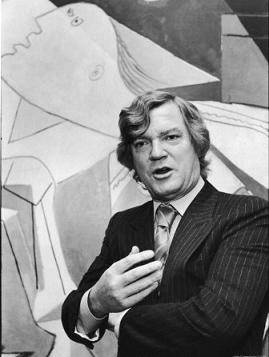 In the early '60s, Hughes was one the first contributors to Oz Magazine, a satirical humor magazine based in Sydney, which eventually became known for its subversive and counter-cultural content.
In the early '60s, Hughes was one the first contributors to Oz Magazine, a satirical humor magazine based in Sydney, which eventually became known for its subversive and counter-cultural content. He left Australia for Europe in 1964, living for a time in Italy before settling in London in 1965, where he wrote for The Spectator, the Daily Telegraph, the Times, and the Observer, among others, and contributed to the London version of Oz.
He immersed himself in the London counterculture of the 60's; during this time he got married to Danne Emerson, which ended in 1981. They had a child together named Danton, who tragically committed suicide in 2001
So judging from his early years - the answer is No! Hardly what one would consider a Conservative!
But, one could say that time changes people, and it certainly must have changed Hughes in the same way we all change and also in his sudden, catastrophic reminder of mortality in Australia.
The Shock of the New
Whilst he was working in London, he gained some broadcasting experience with the BBC, which was a valuable addition to his resume. Also, he did publish a book on Australian Art which was moderately successful.
He must have made a good impression as a writer in London since he was appointed art critic for TIME magazine and moved to New York in 1970, where he soon became an influential voice. Things did not always go smoothly, however. In 1978, Hughes was recruited to become a commentator on ABC's news magazine program 20/20. After only one episode, he was fired and immediately replaced with a seasoned journalist. However, big things were looming on the horizon.
In 1980, the British television network BBC broadcast Hughes' series The Shock of the New, based on Hughes' book of the same name.
How did he get chosen to be a presenter for a high-budget BBC documentary? There must have been many presenters who qualified for the position and surely plenty of jealousy about this "Aussie" who was chosen by the BBC ahead of many eminent British or American Scholars and presenters, but in any event those of us who saw the series were not disappointed.

I think Robert Hughes was a product of his time, in which certain values about life were taken for granted, and most people would have seen the most famous Art critic of his day as being as liberal as one can get. I believe he would have disagreed with the Leftist ideologies so popular in the world today, which probably would have made him a conservative. His way of thinking about Art was to resist the Commodity aspect, which seems to be only about figuring out how to attract the art-buying market and tries to get the attention of wealthy collectors who are only interested in its market value and care nothing about deeply felt concepts, ideas and aesthetics.
But hasn't this element of elitism and its concerns always been evident in Art?
Whilst it's true that even if we go as far back as early Medieval Europe and during the Renaissance. Art's main use was ostensibly for use in the Church as "Religious instructions to the masses," it nevertheless carried ideas and themes that went way beyond the basic necessities of instructional stories for illiterate patrons. Of course, Hughes would be aware of this and would argue the case for the artists themselves, who may have been commissioned by narcissistic Popes and other power brokers of the day, were nevertheless deeply concerned about aesthetics and philosophical arguments about the nature of reality and how it is expressed in our Art.
So . . . one could argue
The art of the elitists has always been for the elitists, and it's only since we live in the "information age" that the illiterate masses are far more literate than before. And maybe that's the biggest difference.
This marketing of art and the jostling for attention among wealthy elitists is not exactly new in "Post Shock of the New Times". It was already denounced and exposed by writers such as Tom Wolfe in his sharply critical, laconic and witty essay called. . .
The Painted Word

The Cover of Wolfe's book is this witty image painted by famous illustrator Norman Rockwell.
We observe an Art critic examining a Jackson Pollock. . . a painting of a painting in two totally contrasting approaches, ironically illustrating the divide between representational art and abstraction.
But why couldn't Robert Hughes weigh in on the direction of Art and use his considerable influence to guide Art back on track to where it should have been, some could ask? But it's way beyond the influence of a single critic, even more so today than in the time of the Greenberg vs Rosenberg era of the 60's and 70's. So Hughes naturally added his acerbic criticism to art that fell beneath his barometer of sincerity and integrity, but effect is really just one more opinion in a plethora of voices all claiming to have the last word. Since the year 2000, it seems the world of Art has become increasingly fragmented as various new young artists simply follow their own support bases regardless of who said what, and if there's a market, there's an artist no matter what the demand.
In 1997 Hughes wrote a book on the history of American Art, called "American Visions: The Epic History of Art in America". It was also subsequently turned into a 6-part documentary series once again, featuring the author. After the unprecedented success of "The Shock of the New," one could forgive the viewer for hoping to see more of the same.
But American Visions, whilst still engaging, well researched as well as presented, somehow lagged and didn't have the freshness and vigour of the previous series.
Publishers Weekly noted, "Hughes writes with an aesthete's disdain for political posturing, a traditionalist's belief in the importance of technical skills (painters are frequently taken to task for their shoddy draftsmanship) and a pragmatist's contempt for mystagogical bunk." (taken from Wikipedia)
After surviving his car crash ordeal as well as writing his biography on Goya, it seems Hughes decided that he would start calling out the naked emperors of the day,
In 2004, Hughes tried doing an update on The Shock of the New, making a one-episode program, the new Shock of the New
He wrote about the update in an article for the Guardian
- "a single programme - a mere 55 minutes - to bring the story up to date from where The Shock of the New left off when we finished making the series, one is bound to fail" - (30 June 2004). "Robert Hughes on updating The Shock Of The New". Guardian.
In the documentary, we do see Hughes in his dry, articulate way inevitably attacking modern art that appears to really only be about attracting attention and doing "anything, to stand out from the crowd and say look, here I am, I'm different"
Hughes does enjoy pointing out irony, and he shares a story about Picasso's Guernica as one of the last pieces of work in which an artist attempts to depict the collective cry against the effects of violence perpetrated on innocent people and probably the likes has not been seen since.
A copy of Guernica was placed in the hall of the United Nations Assembly. This copy was "discreetly" covered up on February 5, 2003, when Colin Powell appeared before the UN to prove the urgency to engage in a war with Iraq, an example of Art not really having an effect on what happens in the " Real World" but rather just a device to display a noble virtue to be put on display at opportune times.

He then talks about the father of modern art since the 60's as being Andy Warhol and his modern progeny Jeff Koons; the idea of forging a niche in the art market is enough since the clientele made up of an elitist group of ultra-rich patrons will compete with each other to buy the latest brand, like an edition of only one Adidas or Gucci. As it so happens, Warhol made many editions of his cans of soup and screen-printed celebrities, as each one was easy enough to reproduce and once the market was secured, it was easy pickings.
Of course Koons has used the same principle, and he happily pays his craftsmen to manufacture his pieces and sells them off for astronomical prices.


The same critique applies to the art of yesterday, which collectors buy as valuable investments; it seems bragging rights among the elite is a fascinating game of one-upmanship for those who are in it.


Is there any hope?
Well yes, according to Hughes, there is! And then he proceeds to discuss the work of several contemporary artists he feels are fulfilling the responsibility of creating great art. After dismissing the work of Damien Hirst and Jeff Koons as "commodity art," he then proceeds to sing the praises of modern artists who have continued the ways of representation using the time-honoured skills of the traditionally trained artist.
I am not attempting to repeat all that was said in the video, but rather to discuss the sections that stood out to me and add an insight or two of my own.
Paula Rego. A masterful storyteller, her pictures are bordering on being illustrations, but they are so much more than that and apart from her brilliant technique, there is a view into her mind shown in stories of dreams in which the familiar becomes menacing and fearful.

The Interrogators Garden
She has many art historical references; there is a nod to the kind of lighting and shadows that remind one of De Chirico's plazas, but she replaces these with her own life experiences. The interiors and people are clearly taken from her own memories in which complex relational situations are replayed. She sets a stage in which her own viewpoint with its fears, attachments and confusion is present, not always understood.
Robert Hughes reminds us that the Portugal that Rego grew up in was a military dictatorship in which she would remember a time of fear and uncertainty. In "Interrogator's Garden there is a reference to the brutality of a military dictatorship from the eyes of a woman who witnesses the cruelty of the entitled male who is convinced of his own untouchability. In this painting, he is shown trying to demonstrate a "softer" side of a gardener, but even though it looks almost comical, there is also a feeling of sexual violence in his manner.


But there is obviously a world of difference between the two; Koons never laid a hand on the sculpture in its creation; he isn't concerned with the process, only with its result. Of course Rego's intense involvement with the process and not just the final image makes it more appealing for Hughes, and in the end, isn't that what we want from Art? Not high-minded jabs at the utilitarian nature of our modern world, but a departure, or escape from it.
Hughes draws attention to a painting by Rego called "The Policeman's Daughter." The Policeman/father's presence is only implied because of the boot and the title. We can clearly infer a connection to brutish masculine domination contrasted with feminine compliance and devotion.
Hughes makes an interesting observation when he asks Paula if the image of a daughter dutifully stroking the boot is a reference to incest. It seemed to me that this idea took Paula by surprise, and she simply said the picture is about obedience and she asked her daughter to pose for it, and then she said probably it is so, but I think she meant it was subliminal.
I couldn't help but feel there was a very strong similarity to another artist with completely different aims, and so I would like to add an aside at this point. I wish I could ask Paula Rego if she was ever influenced at all by the work of Balthus, in technique and lighting, the element of storytelling and the compositions.

In Paula Rego's paintings, the work is highly personal as well as nostalgic, but victimhood and powerlessness is often implied in the work along with many feminist themes. The similarity to Balthus is seen in only a superficial sense: a type of domestic scene with the same kind of lighting and atmosphere, plus the inclusion of pets such as cats, who also add an element of mystery. But I was wondering if Rego could have borrowed from Balthus some elements of lighting and composition and used elements of the dreamlike atmosphere.
 Balthus the famous Polish/Swiss artist famous for his dreamlike images of young girls. His pictures clearly have different concerns.
 He is a voyeur, possessing and claiming the subject from a keyhole. His depictions are always of a pre-pubescent girl, who is shown languidly relaxing and lost in thought, still innocent but on the edge of change physically and mentally.
They are depicted with a domestic veracity but with a Renaissance spirituality.
He always maintained they were untouchable like "angels," perhaps in the same spirit as a Venus, who was not sexually available, a depiction of an ideal state that only exists in the mind.
The child is depicted always at the point of transition from innocence to awareness, a bit like Eve in the Garden just before she plucks the forbidden fruit.
His paintings are beautiful but also disturbing, but not for the same reasons Paula Rego's paintings are. But her paintings of interiors and of domestic scenes always seem to conjure up for me the paintings of Balthus. I guess the connections could really be simply in my own head, although a look at the paintings will soon demonstrate why.
What has Hughes got against Damien Hirst?
 |
Robert Hughes on Damien Hirst"Hirst's 1991 suspended tiger shark, The Physical Impossibility of Death in the Mind of Someone Living, is, Hughes judges, a 'tacky commodity', even though collector Charles Saatchi sold it for £8m in 2004. |
Apparently, a tiger shark was caught specifically for the project and was "sacrificed" for the cause of Art to the deity of novelty and trivia. The sacrificial beast was not disposed of at the end of the ceremony, but is now on view stuck in its tank, swimming forever in Formaldehyde, like a gigantic "specimen", powerless, imprisoned and impotent.
Or so we thought!
Apparently there is a whole other chapter to this sad and twisted story of modern art shenanigans. Soon after the exhibition, the said shark started to decompose in its tank! So it had to be "rescued" from its tank by a taxidermist who then gutted it and covered a fibre-glass frame with the shark's skin before putting it back!
The whole episode did not sit too well with our intrepid art critic, and Hughes in total disgust, stated that "brush marks in the lace collar of a painting by Velázquez could be more radical than a shark "murkily disintegrating in its tank on the other side of the Thames". (The Guardian, 3 June 2004)
But the story doesn't end there either!
When the work was sold (In 2004 for 8 million pounds!) Hirst offered to replace the original shark with a fresh specimen! This time to be properly embalmed like a Pharaoh in its vitrine tomb. So once again the fishing boat was commandeered in the cause of Art to collect a second specimen, another unsuspecting Tiger shark who was caught and killed and dispatched to replace its stuffed predecessor (You can't make this stuff up!)
To cap it all, the whole process provoked a solemn debate about whether replacing the shark meant the original artwork had now changed and was no longer the same piece. (Vogel, Carol "Swimming with famous dead sharks, 2 The New York Times, 1 October 2006)
Hughes talks about the value of an image,
"Not everything of value is self-evident, and there is no reason in the world why art should be. Nor is it true that instantaneous media, such as photography and video, should or can deliver "more" truth than drawing.  All you can say is that they offer a different sort of truth.

This is an issue with which an artist like David Hockney has been struggling for years, and it's fascinating to see how he has given up on the photographic collages he used to make in favour of pure recording in watercolour, of which he is such a master."
Hockney played around for a while experimenting with a Polaroid camera, in which he would record a subject with multitudes of photographs which he would then stick together in order to bring a contemplative and studious element to photography.
This is really fun exercise to be sure, but as Robert Hughes observed, it was not the greatest achievement of Hockney's long career.
Hughes is chatting with Davide Hockney about the sketchbooks he painted in Spain. In his study of the Mosque of Cordoba, Hockney has edited out all the details and tried to capture the essence of what he was observing. He has made an attempt at a new kind of "pure art" by taking his sketchbook into the mosque and, with a large brush and his set of paints, creating the painting direction on locations without using photographic references or even pre-studies. It shows a conscious rejection of "second-hand imagery," almost a purge of his previous work in which he was using hundreds of polaroid photographs.

He discusses with Hughes the comparison between painting and photography and they both agree on the limitations of photography and how painting can do far better.
 Robert Hughes is discussing with Hockney the limitations of the camera. The idea is that a camera is instant and superficial and does not capture the true essence of the place.
 I did find myself wondering though - the ability of the camera to record every detail in an instant compared with Hockney's drastically edited view of the place, which does seem to miss out a lot.
So maybe it's a great record of his experience of having to observe the environment and then going through a sophisticated process of choosing what to include and what to leave out whilst deciding on how to arrange his composition. . . .
It simply seems to suggest to me that painting and photography are different and have different aims and intentions and results; also, painting is warm with the human touch and photography is cold, mechanistic, but very useful in making recordings.
Unlike what we see in Paula Rego's work, we witness in Hockney's work a complete lack of conflict and inner struggle; there's no story or traumatic memory being presented here, but rather something akin to the intentions of the impressionists but with an added simplification they would not have understood. He has no need to exorcise any of his past demons or forgive or confess he is simply recording his experience in the moment.
He does, say, however, when talking of his Yorkshire paintings, they are made up of knowledge of the area that goes back to when he was a child, and it's this experience that adds to painting far more understanding than he would have had having never been there before.

Robert Hughes again admires the purity of the work, its honesty and unpretentiousness, devoid of any need for attention or praise, confident in its own competence.
It is in these examples that Hughes calls for a return to "slow art" as opposed to "fast art" and art that "Holds time as a vase holds water". The very opposite of mass media, like a seaport from the turbulent ocean or an oasis in a scorching desert, an Art of contemplation and of the soul.
Personally, I feel there is a great deal more substance to these landscapes, and I completely believe his explanation for that is a lifetime of actually living there.
 He then moves on to describe the work of Lucian Freud as a fabulous and noble struggle in which he is "engaged in a quest in which he is fighting for every square inch and inviting the viewer to enter with him into the experience", he can even give enormous depth and meaning in a painting of the hindquarters of a horse.
Not included in the film is Freud's portrait of Hockney, characteristically unflattering but still demonstrating the uncompromising struggle that Hughes describes.
And Hughes reiterates a statement of optimism that goes something like
"Upon viewing the work of Freud, painting is far from dead," and there is "beauty in paint being confidently handled not only in figurative but also in abstract." Hughes makes his point in a painting by Freud of the Rear End of a Horse that even in this anonymity, his use of technique in describing the textures, colours and lighting of the horse is enough to raise it to a level of the highest art.

And this does not have to be restricted to figurative art either. . .

 In the paintings of Sean Scully, he describes them as "Big abstracts which retain much more than a memory of experienced architecture, but relate to the human body too", and. . . "there is something wonderfully invigorating about the measured density with which their paint brings them into the world"
Hughes then talks about the concept of "revolution" as a key concept in the minds of younger artists in the modern world and the need to produce some kind of social change in order to justify the work that they do. He doubts whether any art has ever achieved this; he then declares that art has an equally difficult task, that of "being beautiful". Really? 50 years of Art critiquing and it all comes down to this?
This becomes apparent in the examples we have just studied; this whole episode, it seems, is meant to present an art case that is simply "Beautiful". Hughes speaks the word almost as a convert would say the unspeakable, but with the veracity of resignation and his heartfelt apologetics for the necessity of it as a deep-felt human need.

He ends the episode with a look at Olafur Eliasson's gigantic installation, which in 2003 took over all space in Tate Modern, London. The artwork, a sun rising out of a mist, was bound to keep any visitor in awe. In this project, named The Weather Project, the Scandinavian artist recreated the sun and the sky to occupy the Turbine Hall.
The enormous success of the project is evidence indeed of humanity's need for art experiences that elevate our consciousness beyond the monotony and repetition of our daily lives.
After several decades of writing about art and exploring the depths of what art means and how it has developed and changed over time, it is, in the end, a rather simple creed that Hughes appeals for. Perhaps it's not the world that needs an Art of peace, contemplation and Beauty so much as Robert Hughes does, and I say this with the genuine sympathy of the devoted acolyte.
I suspect the new generation of artists and art historians will override such simplistic concerns and return to the struggle for ascendancy as they compete for the highest honours and the hope of immortality.
But it is clearly apparent, at least to some, that this is an empty promise; fame is fleeting, and immortality is reserved for much higher beings. Robert Hughes, after having risen about as high as one can in his chosen field, faced the slow descent into obscurity; it must surely become clear that every pinnacle achieved is followed by an inevitable descent. And upon our demise there is a new generation waiting impatiently in the wings to take their hour upon the stage.
In the savage jungle law that occurs in groups like prides of lions or packs of wolves, as soon as a new leader takes up his position, they become a target for the next generation and remain in ascendancy only for as long as they can physically overpower and dominate the others, until inevitably age catches up with them and they are overthrown, just as they did to their predecessor often after a savage fight, and whilst they fade away out of time and out of memory, the endless cycle repeats itself time and again.


Comments
Post a Comment