05. The Huge Divide
The huge divide
Philosophically the big divide in mentality in the USA of the 50's was between the values of Nihilistic New Yorkers and other pockets of modernist liberalism mostly in the densly populated Urban areas vs traditional values of the conservative and more rural south, which still held sway in most of the country.The Conservative West
The rest of the USA was very much in the rustic camp of the Scene painters, who seemed very much involved with farms and small rustic towns and nature in general, beautiful paintings by gifted Artists, but perhaps a bit out of touch with the modern world of cities and sky scrapers.Grant Wood and Edward Hopper, Andrew Wyatt among others. . .
Here's an example of the work of what are probably the greatests artists in America during the first half of the 20th Century. They became marginalized by the pedantic Rhetoric of the critics who championed the Abstract expressionists and had to be left out of the History of Art Books or be relegated to a section called "scenic or Regional", whilst the "real deal" which was in fact as it turns out, an expensive experiment, an indulgence of wealthy dilettantes which will probably not stand the test of time. . .
 |
| The Railroad House - Edward Hopper 1925 |
 |
| Edward Hopper - New York Movie 1939 |
Hopper's focus is on the Usher as she stands in her own space removed and indifferent to the film she has seen many times over, playing to the anonymous theatre goers, Hopper observes her from a distance a compassionate voyeur we can feel his questions. . . who are you? What are you thinking or feeling - you look bored and lonely.
Hoppers paintings are deeply engaging and moving.
Could Mark Rothkos colour field paintings be more profound? More intimate? More human?
 |
| Automat - Edward Hopper 1927 |
 |
| Breaking the Prairie Sod 1936/7- Grant Wood |
 |
| Christina's World - Andrew Wyeth 1948 |
Its the anonymity of the figure - I had no idea she was a cripple
Andrew knew her very well, but it doesn't matter - it has an atmosphere that speaks of the harshness and beauty of America that has a depth and a vision that reaches into our hearts.
Thomas Hart Benton
whose romanticized paintings and murals depicted the American mid-west perhaps in the way that it wanted itself to be seen. . .
To my mind there is a strong element of Early Walt Disney, I'm not sure if there is a connection. . . and if so, who influenced who? But what works very well in Snow White is not really an approach one can attribute to high minded serious Art. It looks a little cartoonish and formulaic.
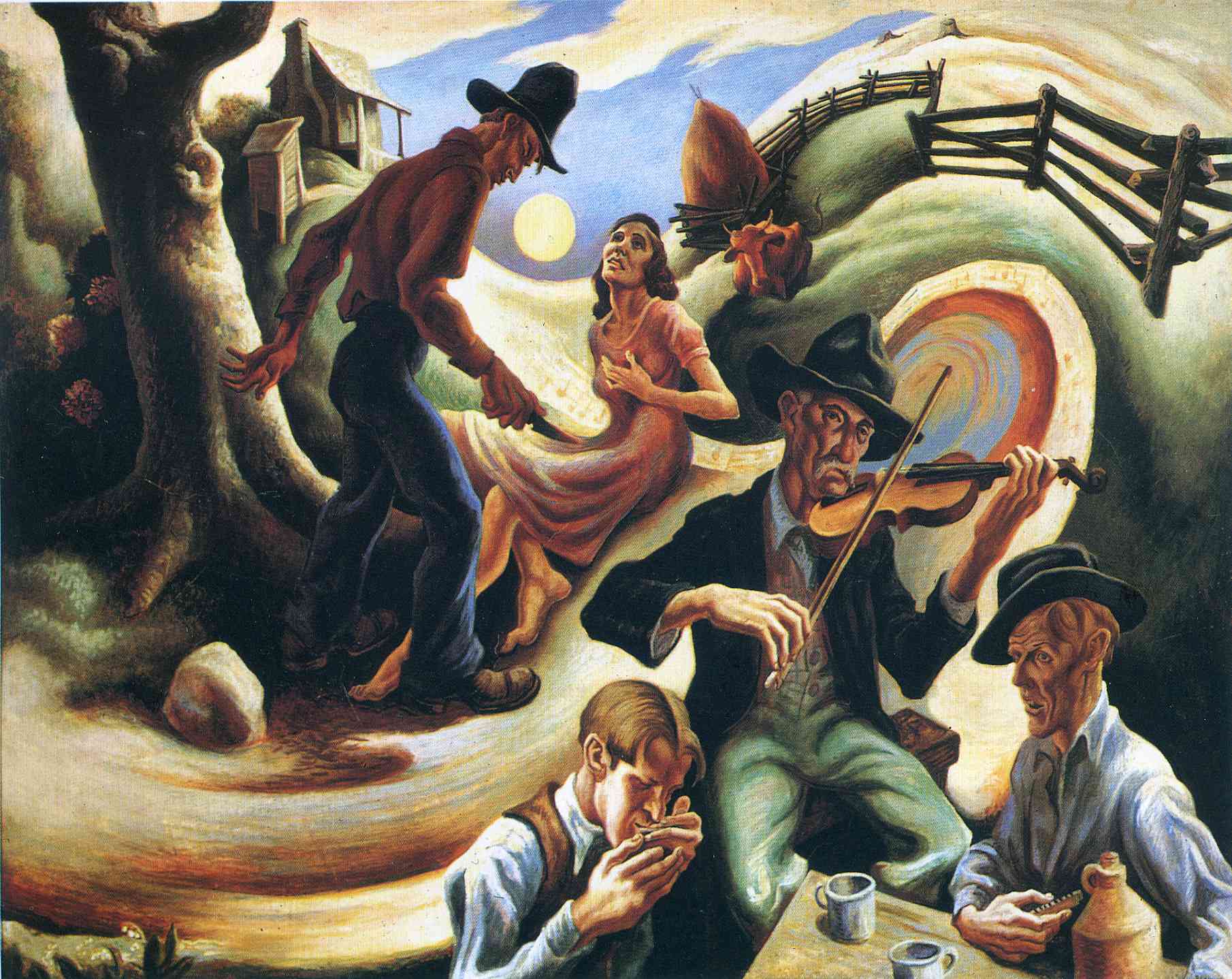 |
| The Ballad of the Jealous Lover of the lone Green Valley - Thomas Hart Benton 1934 |
The average American was not really moved. . .
 |
| Norman Rockwell, The Connoisseur, 1961. Cover illustration for The Saturday Evening Post, January 13, 1962. |
Norman Rockwell
Here his painting is not difficult to read and understand, it is a painting of another (Abstract) painting in a conventional style seems to totally mock the lack of genuine technical skill required to make abstract Art. whilst at the same time it showcases the technical mastery of Rockwell
In the 1950s, there was heated debate about the relative merits of abstract art, realist art, and illustration art, and Rockwell was frequently caught in the crossfire.
 |
| The critic 1955 |
 |
| The Critic 1865 |
In this one he does another version - this time called "The Critic" where the characters mock the shortsited critic, Rockwell's critic echoes the social satire of french satirist Honore Daumier almost a century ago.
A wry crack at the 'institution' of Art and how quickly the literary critics lose sight of what is really important, so weighed down with conventions and Rhetoric it is so ironic that the liberators of modern Art very shortly imposed a different but no leass stultifying orthodoxy onto their expectations of the nouveau "salon Art" of the 20th Century.
Clement Greenberg

In Greenberg’s lexicon, Rockwell’s illustrations were kitsch, popular accessible artworks that appealed to the masses.
This was in contrast to his existentialist principles. Like Nietzsche he wanted to "stare down" the 'abyss' and formulate a new vision for the future of Art.
This in accordance with Dada principals could not "go back" anything that looked representational was tainted with the methodology of the past which had been abandoned 50 years prior.
He created a tight knit formula for abstract Art, which was swallowed wholeheartedly by the Elitists, his arguments with Harold Rosenberg were all "in-house" discussions on the new methodology and the Elitists loved feeling part of the discussion and had vigorous debates about the merits of 'action painting' as opposed to 'colour field painting' the various exponents work was chosen by various representatives of whatever modernist field they adopted, the controversy created an illusion of variety and choice but this was all about whether an Artist was able to fit the literary expectations of Greenberg, or Rosenberg, since in the end it didn't really matter, this was the test of merit not really more traditional virtues.
Greenberg was vociferously promoting the USA as the "fountain head" of Modernism and Europe had to look Westward now for leadership rather than the opposite.
European modernists attracted to the lucrative market of sponsored modernism migrated en masse across the sea to the new Cultural capitol of the World. . .
New York.

Since then the whole exercise has become a Historic curiosity studied by Art students. It had burnt itself out already by the beginning of the 60's, the value of all the Paintings as great Art? highly debatable. . . and yet ironically they still fetch huge prices at auctions, not because of the Art itself but rather because of their Historic "legendary" status.
Instead applying DaDa principles to Abstract expressionism, just eliminating its rambling discourses about what constituted Art, the Art establishment maintained its elitist structures into the 70's and beyond. The key to modern painting was maintaining strict regulations about maintaining the integrity of 'flatness' of the picture plane. Any hint of 'illusion' must be eradicated, to the point of 'staining' the canvas so that the texture of the paint does not create any sense of depth - no matter how shallow. Any Artist who did not conform to this orthodoxy was ignored by the elitists and they could kiss their meal ticket goodbye. The whole system was an ironic repeat of the academic regulations of the French Salon, a century before where the power of the critics could destroy an Artists career with a word or two in the press.
Of course you could just ignore them and like Andrew Wyatt and Edward Hopper make a career for yourself outside the establishment. The fact that their paintings were so excellent forced the Art world to reluctantly include them and so since then they exist in an uneasy alliance.

This short book is more a series of essays which was written in the 70's and is an outsider's view of the New York Art scene and a criticism of the absurdity of the amount of control over all Artistic endeavours by a small circle of Critics.
His challenge to these 'high priests' of culture was met with scorn and derision, just as the Catholic Priests would claim the the Holy Writ is only properly understood when explained by those qualified to do so Tom Wolf was not able to grasp the wisdom and nuances of the
Wolfe was already a famous writer and could not be so easily ignored, but he was not part of the Elite circles and his challenge was met with outrage and indignance.
This has been repeated throughout History, once the mainstream has set its ideas there is no room given to anybody to challenge them.
Whyever not? Question and challenge are the modern way are they not? Perhaps this is the ideal but in fact History merely repeats itself.
Does Abstract Expressionism live up to its own ideals?
No! It never did, nor ever could!
It never brought a message of life or hope, did it? When one compares the materialistic well being of Americans with the Art of Abstract expressionism, it offers a marked disparity. . . these generally large pieces of canvasses full of wild gestures or flat planes of paint, what did they end up saying? All of these are manifestos of the narrow and limited view of painting that is described in the writings of Greenberg and others. No one outside of Universities or elitist circles bothered to read these treatises and didn't really care either way.
Paint it Black
 |
| Mark Rothko's series of black paintings in the Rothko Chapel - great Art? or literary exercise doomed to remain obscure and ultimately to be ignored and forgotten. |
Mark Rothko's final work was a series of paintings that were commissioned by another elitist John de Menil.
He committed suicide before the chapel was even opened. It's not difficult to see his state of mind when contemplating the series of Fourteen of Rothko's paintings. Three walls display triptychs, while the other five walls display single paintings. Rothko began the series back in 1964, experimenting with various hues and tones all on the theme of black.
The point of the chapel is an ecumenical place of worship for contemplation and reflection. . .
But what effect did he expect for the viewer when contemplating these large canvasses of varying shades of black?
. . . So some may extol the virtues of its spirituality and serenity but actually it is neither, and presents the viewer with two specific messages. . .
50 shades of Black
- Rothko's final expression - These paintings are really his manifesto of the emptiness of infinity, not unity of religion and mankind. Nietzsche said "if you stare into the abyss, the abyss stares back at you", this is a depiction of that Abyss and Rothko found out he did not posses the strength of the Übermensch to outstare the void. These particular paintings whilst following the dictates of the current 'colour field' orthodoxy are totally inwardly focussed not outwardly. The only 'ecumenical' declaration he makes is about the shared fate of all mankind, which is universally hopeless, all our hopes endeavours and aspirations ultimately end, and disappear into an eternity of nothingness. This is the expression of a materialist who has no hope sees only pointlessness and feels only despair. . . when one considers his suicide, what other conclusion about his work can we come to? We should take into account the fact that Nietzsche himself could not face the emptiness either, and at the end of his life became insane suffering terribly before his final leap into the vast nothingness of eternity.
- The Proclamation of Elitism - The paintings are housed in a construction designed for them by celebrated architect Philip Johnson. It is a showpiece of modernism, power and wealth made open for the public to view in a designated area. Here the commoners can briefly enjoy a shared experience eith the wealthy Elite as they gaze upon one of their sponsored projects placed on public view. Here we see the religion of wealth that reaches out magnanimously to the commoners in the manner of medieval Kings and Queens who might on specially selected occasions go down the castle hill to mingle with the Serfs and then after an appropriate time retreat back behind their fortified towers.
Here is the declaration of it's professed function and purpose from the sponsors. . .
"The world's first broadly ecumenical center, a holy place open to all religions and belonging to none. It became a center for international cultural, religious, and philosophical exchanges, for colloquia and performances. And it became a place of private prayer for individuals of all faiths"
The Broken Obelisk
 |
| Why would an Egyptian Pyramid and Obelisk be the perfect choice for an ecumenical world religion? |
I sure do wonder what Martin Luther King would have said about it - I have to speculate but I am sure he would not have approved of its elitist undertones, not to mention its totally pagan implications.(unless of course, he became an insider at some stage, which would ensure he understould very well the implications of the obelisk and Pyramid)
Barnett Newman. . ?
 |
| A painting by the seminal American Abstract Expressionist painter Barnett Newman goes under the hammer at Sotheby’s Contemporary Art Evening Sale on 14 May 2013 in New York. |
A modern day article asks whether this painting is worth 30-40million, should the question even need to be asked?
Newman is seen as one of the major figures in abstract expressionism as a painter not well known for his sculpture. He had in fact already made one, in 1967, it stands to this day in New York another commision. The Menils wanted exactly the same thing for their chapel, the perfect depiction of their elitist concerns, was this the idea of the artist or was he simply selected, and paid handsomely to create an already existing concept?
Well the sculpture does raise some questions as to its relevancy. What is the connection between these ancient Egyptian symbols and a black minister campaigning for civil rights? Admittedly we do however see an Obelisk in Washington, the place of Martin Luther's famous "I have a dream" address, so some will make a connection here. But there is far more of a connection to the aims of the Elitists and to symbols found in Free Masonry and the "New World Order" a specific Elitist concern that had no relationship to the thinking and aspirations of the average American citizen or civil rights.
But by this stage nobody outside of this "circle of elitism" had any idea what was going on in Art and were too either too ignorant to ask questions or had given up trying to understand.
At the end of the first World War, there were a great many writers and artists who resented authority and were consciously trying to restart culture. But they were individuals whose works were interesting literary novelties read by scholars trying to come to grips with atheism as a world view. But there was not really a specific mouthpiece that could be identified as belonging specifically to young people, not until the the 1950's postwar baby boomers came of age.The Only mouthpiece for young people's fears and aspirations came from a literary movement.
The Beat poets


Comments
Post a Comment